Understanding Coffee Roasts
Roast Chemistry & Flavor Architecture

Understanding Coffee Roasts

• Olivia Reed • 7 min read • Roastery Notes
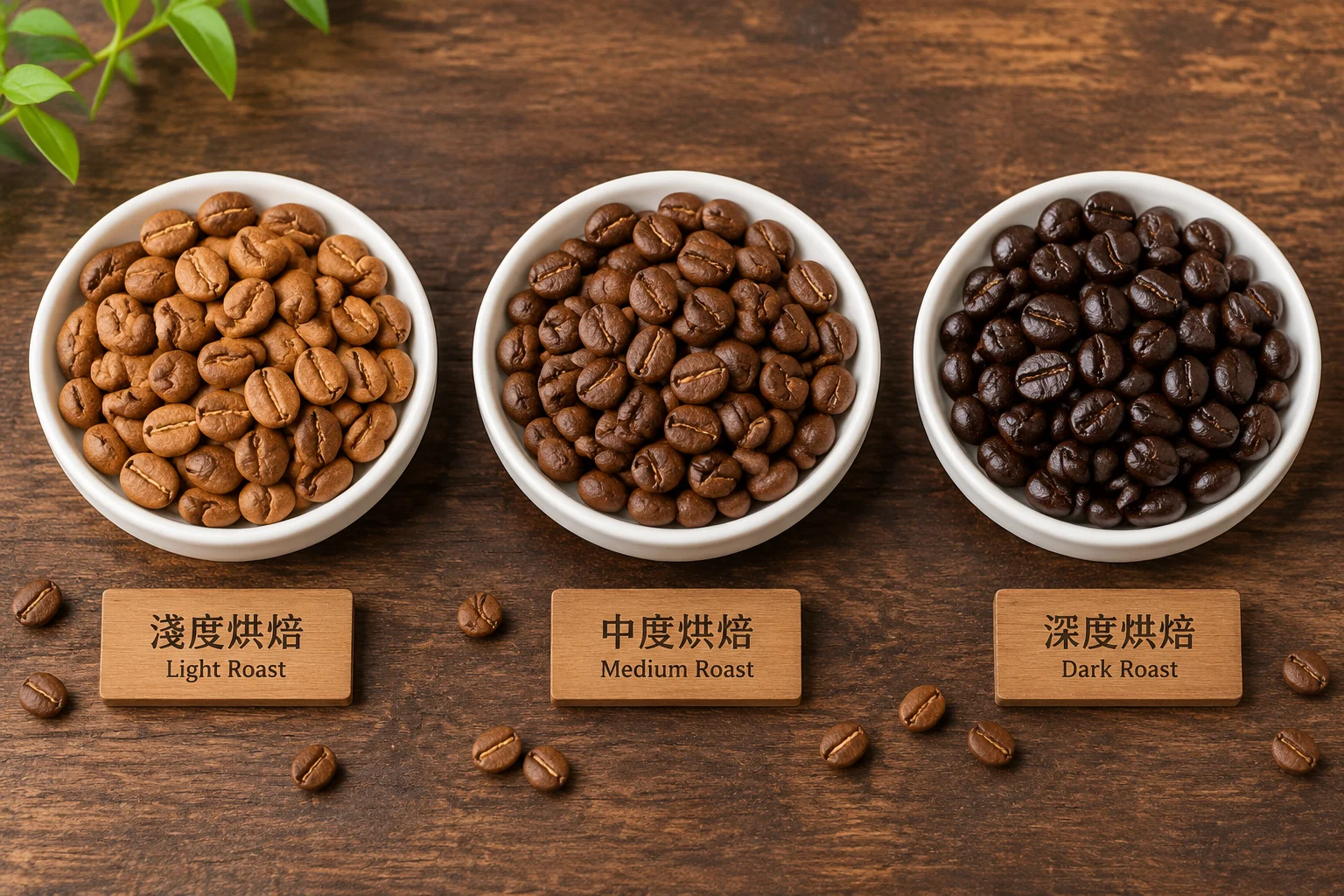
Three small bowls displaying light, medium, and dark roasted coffee beans.
JOURNAL
Curator Summary

The Thermal Spectrum from First Crack to Dark Pyrolysis

Green coffee beans hold dense cellulose matrices packed with chlorogenic acids, trigonelline, and dormant sucrose. Subjecting those seeds to controlled thermal convection unlocks non-enzymatic browning and precise cellular fracturing, shifting the beverage from crisp botanical brightness to rich caramelized complexity.

Key Botanical & Brewing Facts
Botanical Lineage Coffea Arabica (Bourbon, Typica, Gesha)
Harvest Region High-Altitude Equatorial Belts (1,600m–2,200m)
Water Temperature 90°C – 94°C (194°F – 201°F) based on density
Steep / Extraction Time 2:45 to 3:30 min (Filter) / 25–30 sec (Espresso)
Flavor Spectrum Crisp Malic Acidity, Caramelized Sugars, Roasted Cacao

Experience Freshly Roasted Single Origins

Explore our hand-roasted Colombian Arabica and vibrant Ethiopian micro-lots in our cellar pantry.

From Endothermic Drying to Exothermic Expansion

Raw coffee beans arrive at the roastery containing between 10% and 12% moisture. The initial stage in the rotating drum is purely endothermic, absorbing continuous convective heat to evaporate internal water until the beans shift from grassy green to pale straw yellow.

As the core temperature reaches approximately 160°C, the Maillard reaction triggers hundreds of aromatic compounds. Amino acids bond with simple sugars to produce melanoidins, generating the golden brown hues and early biscuity aromas that define specialty roasting.

A roast master does not force flavor into the bean; she orchestrates thermodynamics to reveal what altitude, volcanic soil, and careful fermentation have already written.

Olivia Reed — Lead Roast Master

Between 196°C and 205°C, vapor pressure ruptures the rigid cell walls. This audible milestone, known throughout the craft as the first crack, marks the precise transition from raw seed chemistry into soluble specialty coffee.

Bean Density, Acidity Preservation, and Caramelization

Roast designations reflect the duration and peak temperature beans experience after passing the first crack threshold. Rather than merely darkening in shade, the physical bean expands, sheds chaff, and undergoes gradual chemical caramelization.

Light to Medium-Light

Discharged shortly after the completion of the first crack. Preserves delicate citric acidity, floral aromatics, and terroir-specific notes characteristic of high-elevation Ethiopian and Kenyan lots.

Medium to Dark Profiles

Developed further into sugar browning. Acidity softens into round chocolate and toffee notes, while prolonged thermal development yields smoky undertones, heavier body, and micro-surface oils.

Darker roasts break down cell structures more aggressively, creating higher porosity that makes solubles release rapidly during pressurized brewing.

Calibrating Temperature, Ratio, and Contact Time

Because different roast styles feature vastly divergent cellular densities, using identical water parameters across all beans guarantees unbalanced extraction. Tailor your brew methods around bean porosity and heat conductivity.

  • Light Roasts (Dense Matrix): Use water at 93°C–95°C with a medium-fine grind to assist heat penetration and fully extract complex floral esters without sourness.
  • Medium Roasts (Balanced Porosity): Brew between 90°C–92°C using standard pour-over or immersion ratios to emphasize stone fruit and creamy caramel layers.
  • Dark Roasts (High Porosity): Drop water temperature to 85°C–88°C and coarsen the grind slightly to prevent over-extracting astringent phenolic compounds.

Resting freshly roasted whole beans for five to ten days after roasting lets trapped carbon dioxide degas gently, ensuring uniform water saturation and smooth extraction.

Reader Observations

Archived Notes (0)

No comments yet. Be the first to leave a comment.

Submit an Editorial Note

Olivia Reed
Article Contributor

Olivia Reed

Olivia Reed is a licensed Q-Grader and lead roast master at Lextationmakt. With over a decade sourcing micro-lots across Latin America and East Africa, she conducts thermal extraction research and curates cupping laboratories.

Licensed Q-Grader & Lead Roaster • Lextationmakt Sensory Lab